
We can build the study for you
The team behind the software also runs flow studies, for public agencies, sector organisations and companies. Fifteen studies are public in our gallery.
Visualisation
You have the data; we turn it into clear, publishable interactive Sankey diagrams with dynamic filters, hosted or embedded on your site.
on quote
Reconciliation & analysis
Your data is incomplete or inconsistent. We structure it, reconcile it under constraints, quantify uncertainties, and deliver a defensible material balance.
on quote
Full study
From scratch: scoping, data research and collection, reconciliation, analysis and interactive publication: the complete pipeline used in our public studies.
on scope
Print-quality deliverables
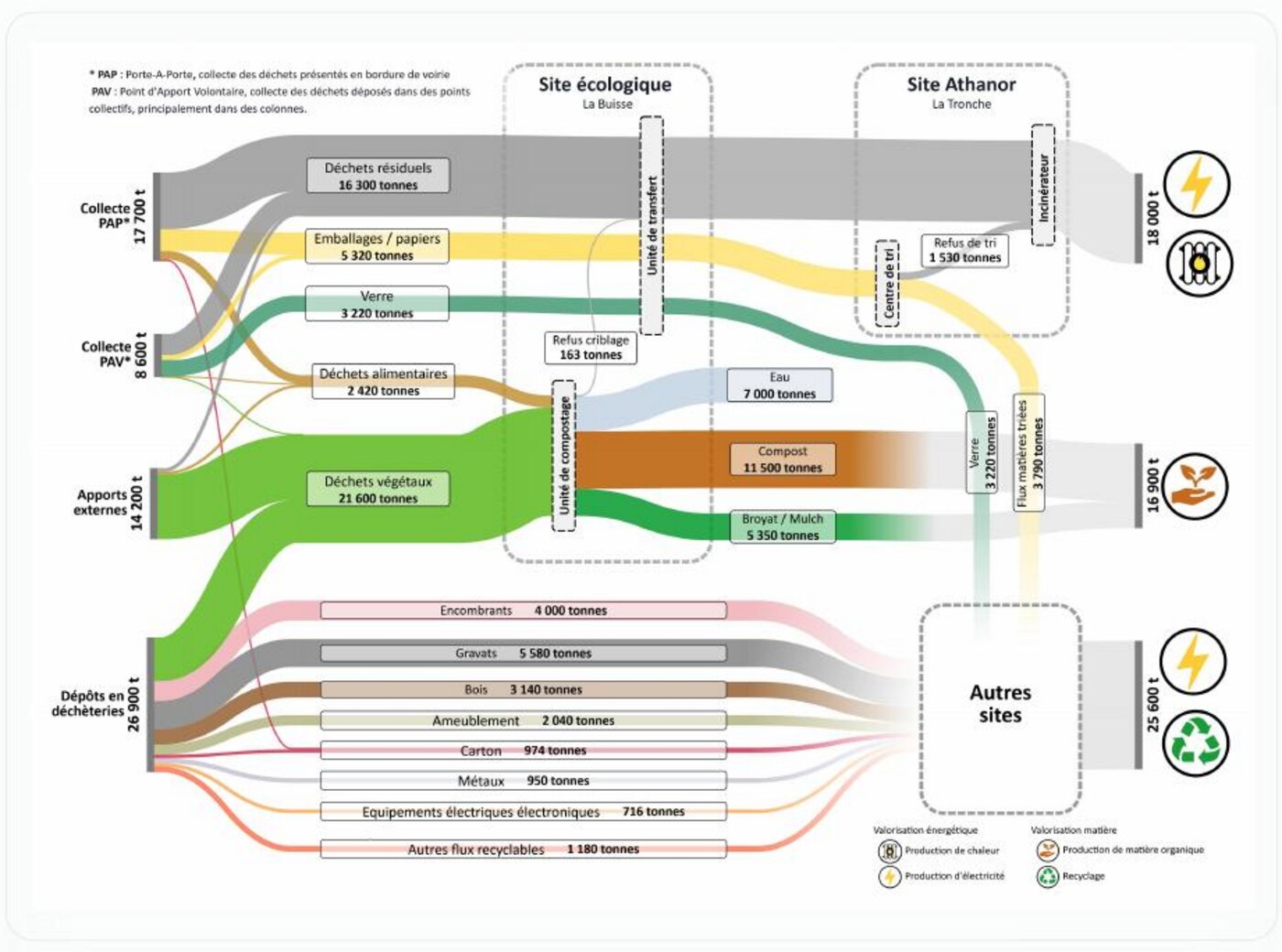
A static Sankey, publishable as-is: this diagram comes straight from the printed waste report we delivered to the Pays Voironnais. See the study →
Training & coaching
Three courses: the group course on material and energy flow analysis (3 days, with Inria and Metabolism of Cities, €1,500 per person) then two advanced in-house days on the tool, MFASankey Dataviz and MFASankey Réconciliation (€1,200 per day, up to 6 people). FluxService is remote coaching booked per 30-minute slot (€75/30 min). See the courses.
How an engagement runs
Four steps: define the flow structure together; collect data with uncertainties; reconcile and analyse; deliver interactive diagrams plus the underlying Excel files. You keep everything, in open formats only.
What makes a flow map actually useful
A successful flow analysis is not the one that is correct: it is the one that gets used. In the edited volume Métabolisme des systèmes agri-alimentaires (Éditions Quae) we co-authored a framework naming the four conditions (built on five projects, including RefFlux, which we led). It is the backbone of how we run an engagement.
Feasibility
Can the data actually be collected, the analysis built and the representations produced in the time available? That is settled at framing, not halfway through. On RefFlux the collection was expensive, but it is an investment: later studies no longer have to redo it.
Accessibility
The full diagram is almost always too complex for anyone who does not read one every day. The answer is not to simplify the model, but to draw selected views from it with the experts of each supply chain, plus filters by issue.
Credibility
Sources, assumptions and uncertainties shown in the interface, so that everyone can judge for themselves how reliable a figure is. That is what lets a result hold up in an adversarial discussion instead of being dismissed as a black box.
Relevance
Does the study answer a question stakeholders are actually asking? That is prepared beforehand, checked during the workshop, and assessed afterwards. It is the condition most often forgotten, and the one that decides whether results are picked up.
The main lesson from that work: involve domain experts from the modelling stage onwards, not only at the final presentation. That is what made RefFlux feasible, and why its results are now used by the supply chains themselves.