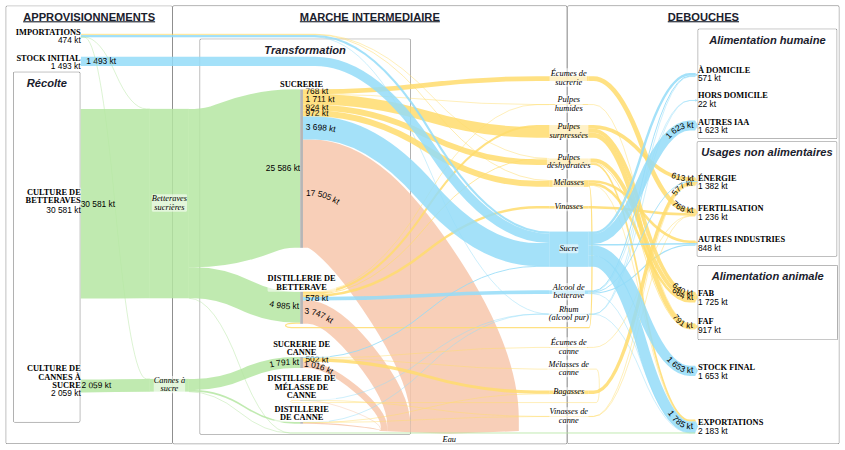
The flow diagram presenting the results for this supply chain, produced as part of the SOCLE project, offers a complete view of how material circulates through the chain, from supplies to final outlets. It is a Sankey-type representation: the thickness of the arrows is proportional to the quantities (in kilotonnes, kt — alcohol and rum being counted in kt of pure alcohol), making it possible to grasp at a glance the relative weight of each segment.
This diagram aims to represent the supply chain as a whole at the level of detail allowed by the available public data. Two raw materials — sugar beet (mainland France) and sugarcane (overseas) — are brought together around a single Sugar node. The chain is modelled as "sugar only": the trade balance of processed sugar-containing products (confectionery, drinks, etc.), which are not detailed here, is attached to the flow from sugar to the agri-food industries.
The diagram represents all the material flows within the sugar supply chain in France, from supply sources to the various final uses, for the 3 crop years studied in the SOCLE project: 2015/16, 2019/20 and 2023/24 (select the desired year in the timeline below the diagram).
Supplies include the national production of sugar beet (mainland France) and sugarcane (overseas departments), supplemented by imports and trade (beet, cane, sugar, molasses, dehydrated pulp, alcohol, rum). The intermediate market highlights the processing operations: the sugar factories (beet and cane) produce the sugar; the distilleries produce beet alcohol (from beet for industrial use) and rum (sugar-factory rum from cane molasses, agricultural rum from cane juice). This stage generates the co-products (pulp, molasses, filter cake, vinasse, bagasse) and removes the water contained in the raw material — by far the largest flow by mass, determined by balance. The outlets include the uses of sugar (at-home consumption, agri-food industries, other industrial uses, exports), those of beet alcohol (biofuel, at-home and out-of-home beverage consumption, perfumery / pharmaceuticals / industry, exports), those of rum (at-home and out-of-home consumption, exports), as well as the recovery of the co-products (animal feed, energy through anaerobic digestion and combustion, fertilisation through land spreading, other industries).
The thickness of the flows makes it possible to identify the main recovery routes, the weight of the water removed during processing, the importance of sugar exports, and the structuring role of the co-products in the balance of the chain.