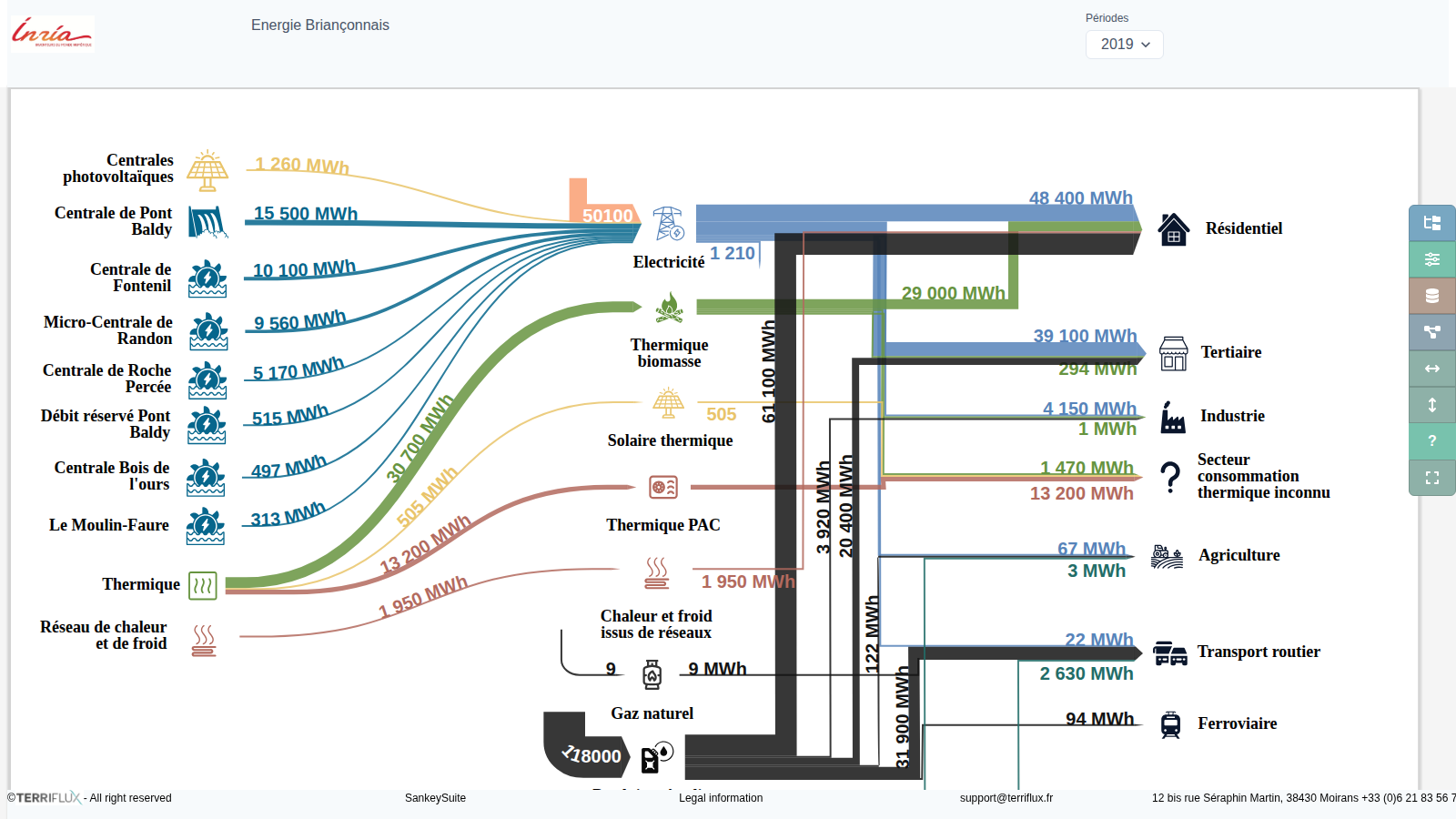
This diagram describes the energy system of the Grand Briançonnais (Hautes-Alpes, French Alps), from local production and imports through to end uses, sector by sector. It was built by Emmanuel Krieger as part of his PhD in the STEEP team (Inria Grenoble / Université Grenoble Alpes / LJK), using TerriFlux tools (OpenSankey, flow reconciliation). It was not designed as a stand-alone assessment: it is the mediation object of a territorial dialogue on energy conducted with the PETR du Grand Briançonnais — 3 inter-municipal authorities, 36 municipalities — in an area marked by recurring conflicts over mountain hydropower plants.
An energy Sankey diagram in MWh, for the years 2019, 2020 and 2021, organised into five levels of detail that the reader can unfold at will: from the overall resources → carriers → uses picture down to individual production facilities (the Pont Baldy, Fontenil, Roche Percée and Bois de l'Ours hydropower plants, micro-plants, photovoltaics, thermal biomass, heat pumps, solar thermal) and sectoral consumption (residential, tertiary broken down by branch, industry, agriculture, transport, municipal facilities). Around 110 nodes and 650 flows, with imports and exports made explicit carrier by carrier — electricity, petroleum products, natural gas, fuelwood, biofuels.
The 2020 vintage makes the imprint of the health crisis readable on a territory whose economy is strongly seasonal.
The diagram follows the AF Filières method: definition of the energy-system structure, data collection, multi-source reconciliation with uncertainty handling, and Sankey rendering. It relies mainly on open data, complemented by modelling wherever territorial data is missing — which is where most of the work lies:
The diagram was built to be discussed. The participatory process, led by STEEP together with Nils Ferrand's team (INRAE), covers energy, water, biodiversity and territorial development: launched in 2022 (CNRS-MITI funding), presented to the mayors' conference in November 2023, dialogue started in early 2024, feedback workshops on the diagrams in December 2024 — including an assessment of the effect of the diagrams on the discussion itself — and conclusion of the dialogue at the end of 2025. A serious game (EnerKey) was developed for this case study.
It is the STEEP team's first large-scale participatory project, and a highlight of its 2025 activity report.
This work was carried out as part of a PhD within the STEEP research team, with no commercial funding.