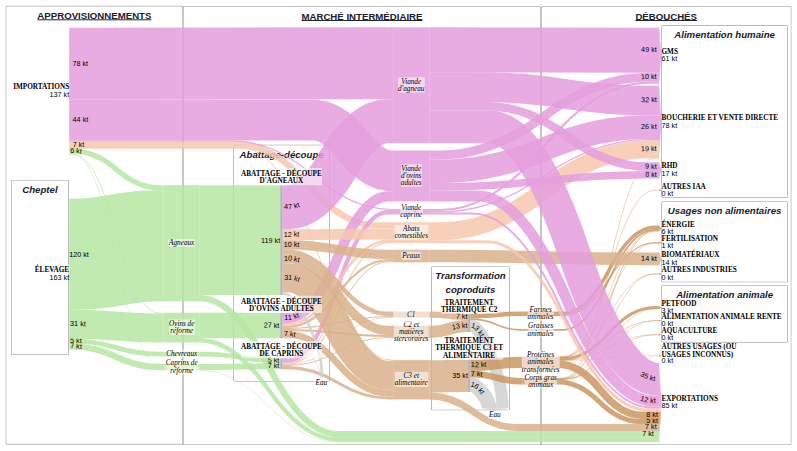
The flow diagram presenting the results for this supply chain, produced as part of the SOCLE project, offers a complete view of how material circulates through the chain, from supplies to final outlets. It is a Sankey-type representation: the thickness of the arrows is proportional to the quantities (in kilotonnes, kt, live weight at slaughter entry), making it possible to grasp at a glance the relative weight of each segment.
This diagram aims to represent the supply chain as a whole at the most detailed level possible. Although some data could be mobilised at a finer level of detail than the one shown, it did not make it possible to guarantee complete data all along the chain: such data is therefore shown in aggregated form on the diagram.
The diagram represents all the material flows within the sheep and goat meat supply chain in France, from supply sources to the various final uses, for the 3 years studied in the SOCLE project: 2015, 2019 and 2023 (select the desired year in the timeline below the diagram). Sheep and goats are distinguished all along the chain; the meat is detailed into lamb meat, adult sheep meat and goat meat (three distinct slaughter routes). Industrial processing and prepared products are not modelled, sheep meat being sold almost exclusively fresh.
Supplies include finished animals from national farming, supplemented by substantial imports (live animals and meat) that cover about half of French consumption. These flows feed the slaughtering and cutting circuits. The intermediate market highlights the slaughtering and cutting operations — distinguishing lambs, adult sheep and goats — and the separation between meat intended for human consumption and co-products (offal, specified risk material, fats, hides and skins, residues, drip water). Part of these co-products is directed to rendering and specific treatments before recovery. The outlets include human food (mass retail, butchers and direct sales, out-of-home catering), non-food or industrial uses (biomaterials from hides and skins — leather, wool —, energy, fertilisation), as well as exports.
The thickness of the flows makes it possible to identify the main recovery routes, the structuring role of imports and co-products in the balance of the chain, and the diversity of the final uses of the material produced by sheep and goat farming.