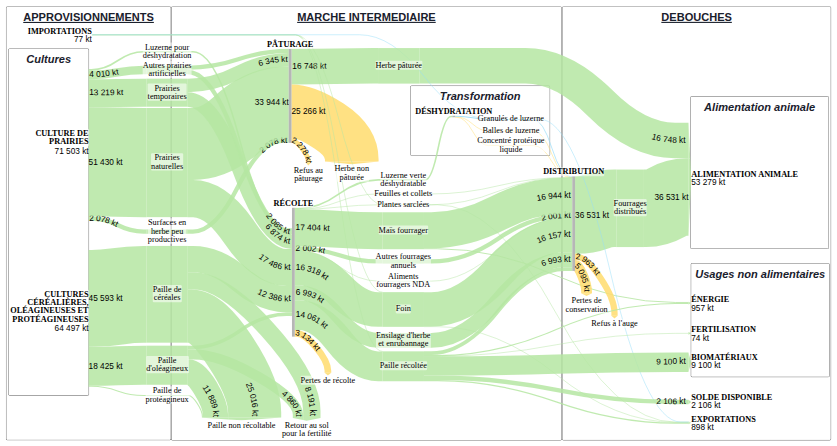
The flow diagram presenting the results for this supply chain, produced as part of the SOCLE project, offers a complete view of how material circulates, from production in the field to final uses. It is a Sankey-type representation: the thickness of the arrows is proportional to the quantities, expressed in kilotonnes of dry matter (ktMS), making it possible to grasp at a glance the relative weight of each segment.
This diagram aims to represent the supply chain as a whole at the level of detail allowed by the available public data, for the 3 crop years studied in the SOCLE project: 2015-16, 2019-20 and 2023-24 (select the desired year in the timeline below the diagram).
The perimeter brings together two sets: forage crops (plant productions specifically intended for animal feed — the residues and co-products of other crops are modelled in the corresponding SOCLE supply chains) and straw (a co-product of field crops), for which total production and all uses are represented.
The chain follows two distinct production logics, which agricultural statistics themselves name. For grassland, the published data is a production available in the field, upstream of any removal: the diagram therefore shows the grazing and harvesting operations that follow, with their losses. For annual forage crops (maize in particular), the data is already a harvested production: those flows start directly at the harvesting stage.
Supplies include the national production of grass (natural, temporary and sown grassland, low-productivity areas), forage maize, various forage plants and straw (cereals, oilseeds, protein crops), supplemented by foreign trade (imports and exports of hay, lucerne pellets and straw). The intermediate market highlights the operations: grazing (the grass grazed, but also refusals, trampling and the grass which, in a good year, is never removed); harvesting (hay, silage and wrapped bales, with their field losses); the dehydration of lucerne (pellets, bales, protein concentrate); distribution to the animals (with conservation losses and refusals at the trough). The outlets include animal consumption (fed by the distributed forage and the grazed grass) and, for straw, all of its uses: return to the soil (straw that cannot be harvested, and straw returned for fertility), bedding and biobased materials, energy (anaerobic digestion, combustion), fertilisation (mulching, mushroom substrate), animal feed, and an unallocated available balance.
The thickness of the flows makes it possible to identify the main recovery routes, the decisive weight of the grass not removed in good years, the overwhelming share of straw that never leaves the field, and the role of bedding in the recovery of the harvested straw.