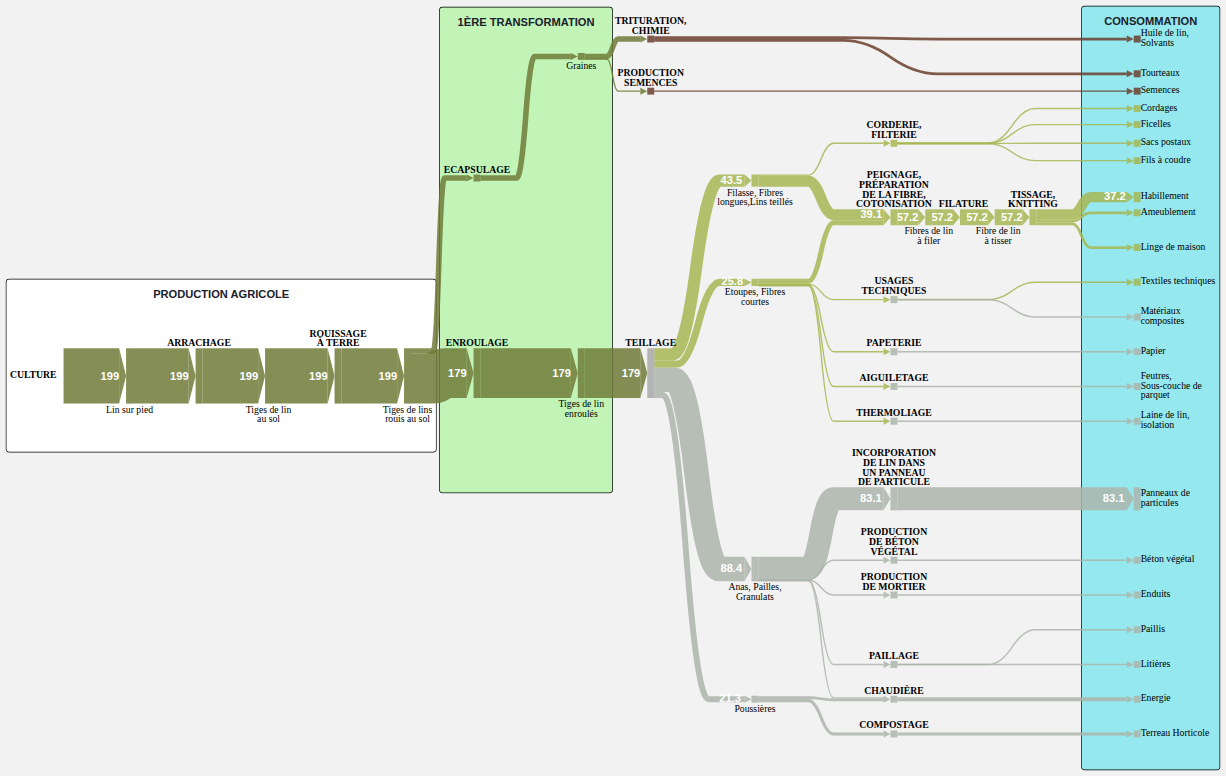
Hauts-de-France is a major producer of agricultural biomass, whose co-products (straw, pulps, oilseed meals, fibres…) feed numerous processing industries. To support the development of the regional bioeconomy, the ORBE collective (Regional Observatory of Biomass and Bioeconomy in Hauts-de-France) launched material flow analyses of these supply chains in 2022. TerriFlux carried out the first chains and trained the collective in the method, so that it could continue the work independently.
Four supply chains are represented, each as a Sankey diagram: Flax (default view), Starch, Rapeseed and Sugar. Each diagram traces the path of the material, from regional agricultural production through processing to end uses, co-products included. The underlying data workbooks can be downloaded from the page.
The data behind these diagrams, drawn from bibliographic sources and interviews with supply-chain stakeholders, are sensitive and constantly evolving: they are not an exact reflection of actual flows, and the purpose of the tool is to get closer to reality by involving all the stakeholders of the Hauts-de-France supply chains.
The study applies the AF Filières method: defining the structure of the supply chain (products, sectors, mass balances), collecting data together with their uncertainties, reconciling the data through constrained optimisation, and finally representing the results as Sankey diagrams. The supply-chain structures and the data were gathered by the ORBE collective; the reconciliation and the diagrams were produced by TerriFlux.
The ORBE collective brings together Agro-Transfert Ressources et Territoires, the Regional Chamber of Agriculture of Hauts-de-France, UniLaSalle, La Coopération Agricole and Bioeconomy For Change. The observatory is funded by the Hauts-de-France Region and ADEME.